Sunday, March 26, 2017
Meaning of Terms used in Mobile cell Phone Repairing
Meaning of Terms used in Mobile cell Phone Repairing
Before you learn how to repair a mobile, it is very important to understand meanings of some of the important terms used during mobile cell phone repairing. Read and understand these terms and their meaning. This will help you later in mobile phone repairing.
- 1G: 1St Generation in Mobile Telephony.
- 2G: 2Nd Generation in Mobile Telephony.
- 3G: 3Rd Generation in Mobile Telephony.
- 4G: 4Th Generation in Mobile Telephony.
- AC: Alternate Current.
- BGA: Ball Grid Array.
- BSI: Battery Status Indicator.
- CDMA: Code Division Multiple Access.
- CPU: Central Processing Unit.
- DCT: Digital Core Technology.
- DC: Direct Current.
- GSM: Global System for Mobile Communications.
- IMEI: International Mobile Equipment Identity.
- IC: Integrated Circuit.
- LED: Light Emitting Diode.
- PDA: Personal Digital Assistant.
- PFO: Power Frequency Oscillator.
- PCB: Printed Circuit Board.
- RF: Radio Frequency.
- RAM: Random Access Memory.
- ROM: Read Only Memory.
- RTC: Real Time Clock.
- RX: Receive / Receiver (Receiving Section).
- TX: Transmit (Transmitting Section).
- SMD: Surface Mount Device.
- UEM: Universal Energy Manager.
- VCO: Voltage-Controlled Oscillator.
Available link for download
.png)

Saturday, March 25, 2017
Mobile Celluar Phone Drivers
Mobile Celluar Phone Drivers
Mobile Celluar Phone Driver
| BLACKBERRY driver | |
| NOKIA DRIVER | |
| sharp driver | |
| Auto_driver.rar | |
| DellStreak_Driver.rar | |
| setup.msi activesync for HTC | |
| ZTE_F156_JoinMe.zip | |
| ZTE_T6.rar NoDevice.com is the place to find any device driver you need. Categories
|
Available link for download
Monday, March 20, 2017
Malay Proverb Detection Implementation on Mobile Environment
Malay Proverb Detection Implementation on Mobile Environment
This is the list of papers presented in the MobilCase 2012.
1st International Conference on Mobile Learning, Applications, and Services (mobilcase2012) – organised by UTEM, Malaysia.

Download the PDF version at –> http://www.scribd.com/doc/115258852/Malay-Proverb-Detection-Implementation-on-Mobile-Environment-MobilCase2012
Khirulnizam Abd Rahman, Norita Md Norwawi
Faculty of Science and Technology
Universiti Sains Islam Malaysia
khirulnizam@gmail.com
Abstract: This paper is to describe the design and implementation of Malay proverbs (peribahasa) automated detection on mobile platform. Proverb is a unique feature of Malay language in which a message or advice is not communicated indirectly through metaphoric phrases. However, the use of proverb will cause confusion or misinterpretation if one does not familiar with the phrases since they cannot be translated literally, yet logically. Therefore, this application was developed to identify proverbs appear in Malay text and display their actual meaning from the dictionary. The recognition process is done using the look-ahead and regular-expression matching approach.
Keywords: proverb automated detection, proverb detection, pattern matching, and information retrieval.
I. INTRODUCTION
Proverbs (peribahasa) in Malay language are beautiful elements to deliver advices, Malay teachings, moral values and comparison through metaphoric phrases [9]. They are normally short, generally known sentence of the folk which contains wisdom, truth, morals, and traditional views in a metaphorical, fixed and memorable form and which is handed down from generation to generation [5]. Although proverbs do beautifies Malay literature, however this brings challenges to machine translation since proverb cannot be translated literally, rather logically [4].
There are four categories of Malay proverbs (as described by Abdullah & Ainon [1]) which are simpulan bahasa, perumpamaan, bidalan and pepatah.
Simpulan bahasa – normally consist of two words. The literal meaning of the word combination is different than the actual meaning of the ‘simpulan bahasa’. Example: Langkah kanan; literally means right footstep, yet the actual meaning is lucky.
Perumpamaan – phrases started with seolah-olah, ibarat, bak, seperti, macam, bagai or laksana. Example: bagaikan pinang dibelah dua; literally means like betel nut split apart evenly, yet the actual meaning is compatible / equally beautiful and handsome for a pair of just married bride and bridegroom.
Pepatah – proverb that contains advices or teachings. Example: Adat berperang, yang kalah jadi abu, menang jadi arang; literally means in war, loser become ashes, winner become coal, yet the actual meaning is in war, the defeated and the winner are both losers.
Bidalan – phrases (pepatah) that started with jangan, biar or ingat. Example: Kalau kail panjang sejengkal, lautan dalam jangan diduga; literally means if you have a short hook, do not attempt to fish in the deep sea, yet the actual meaning is if you have little knowledge, do not dare to dream big.
Technically, simpulan bahasa contains two combined words, and the rest of the categories have more than two words. This number of words criteria is important in the identification process of proverbs.
II. PREVIOUS WORKS
Proverb is one category of multiword expressions (MWE). There’s a research by Rais et. al. [6] indexing the Malay MWE using combination of query translation approach and weighting schemes. The researchers stressed about having a good dictionary are crucial in multiword detection. However, there’s another work by Aiti et. al [2] suggesting several linguistic patterns in MWEs detection. Still the system needs to rely on 412,228 words of Malay corpus.
On other researches directly focusing on proverbs, Brahmaleen et. al. [3] suggested a method in identifying proverbs in Hindi text and translates them into Punjabi. The approach implemented is pattern matching. The machine has a dictionary to map the Hindi proverb and the equivalent proverb in Punjabi.
There is another research from ATMA, UKM whereby they are providing a searchable database of Malay proverbs and idioms [8]. The application receives a complete or a part of proverb/idioms, using the SQL pattern matching to search the list of the proverbs/idioms, and the outputs are all the proverbs/idioms that similar to the user’s request.
Dmitra [4] studied the METIS II translation engine which capable of translating several languages such as Dutch, German, Greek and Spanish into English. The pre-translation process involves tokenization, lemmatization, tagging and chunker. By using the existing METIS II facilities, she managed to embed an idioms translation tool for Germany into English. However, the proverb detection is using the syntactic matching rules approach which is not to be elaborated in this paper.
III. THE DESIGN
The researchers decided to experiment with the combination of look-ahead and regular-expression matching approach approach. By using these approaches, the Malay input text will be tokenized and compared to the proverb database. The searching process is done by combining a token to the next one. This combination of tokens is then searched in the proverb database. The output is the list of proverb detected in the input text, with the meaning of each proverb. The processes are summarized in the Figure 1.
The database consists of 3000 Malay proverbs, resides in the phone itself. This is to minimize bandwidth consumption and also for faster result display. A simple approach is used to identify simpulan bahasa; it is formed by two combined words (Algorithm 1). As for the rest of the Malay proverbs, the Algorithm 2 is implemented. These algorithms are implemented in the proverb detection module of the application, after tokenization (Figure 1).
| While not-end-of-sentence words-combined = wi wi+1 Search words-combine in proverb-database If found in proverb-database Put words-combined in the proverb-list- output i=i+2 Else i++ Wend |
Algorithm 1: To detect simpulan bahasa.
| While not-end-of-sentence words-combined = wi wi+1 wi+2 Search words-combined in proverb-database If found in proverb-database Put words-combined in the proverb-list-output i=i+number-of-words-in-proverb-detected Else i++ Wend |
Algorithm 2: To detect other proverb (other than simpulan bahasa).

Figure 1. Implementation of Malay proverb identification using pattern matching approach.
IV. DISCUSSIONS
These are several challenges in identifying Malay proverbs in text using pattern matching;
a) Word with affixes – Example: “Kembang sayap” = “Mengembangkan sayap” (spread your wings).
b) Another word in between (stopword)
Example: “berpijak di bumi nyata” or sometimes “berpijak di bumi yang nyata” which means “do not day-dreaming”.
The researchers found out that by using simple pattern matching, it failed to detect proverbs that have the aforementioned problems.
Another challenge is to determine the right meaning for proverb that has ambiguous meaning – the same proverbs may have more than one meaning [8]. However in this experiment, all meanings are listed for proverb with ambiguous meaning. For example;
— “mata air” means 1) lover, or 2) underground water resource.
— “orang putih” means 1) pious man, or 2) European (white) people.
— “air muka” means 1) face, 2) pride.
— “bawa diri” means 1) running away, 2) sulking, 3) being independent.
— “bagai cicak makan kapur” means 1) ashamed because of his own offense, 2) pleased.
— “ada air adalah ikan” means 1) there must be people in a country, 2) fortune is everywhere.
V. CONCLUSIONS
Brief testing and observation has been done to the result of this application. The researchers concluded that there are much more to be improved, including introducing another approach. One of the approaches to be studied is the syntactic matching rules proposed by Dmitra [4] for detecting Germany idioms.
This Malay proverb identifier is a prototype to experiment with the pattern matching approach on mobile platform. Though it is still in experimentation stage, the researchers hope that it could contribute to the public by facilitating the new Malay language learner. The application mentioned is available currently for Android platform at http://bit.ly/pbahasa .
VI. REFERENCES
[1] Abdullah Hassan and Ainon Mohd. 2011. Kamus Peribahasa Kontemporari, Edisi Ketiga. PTS Professional Publishing.
[2] Aiti Aw, Sharifah Mahani Aljunied and Haizhou Li. 2009. Malay Multi-word Expression Translation. Second Workshop on Technologies and Corpora for Asia-Pacific Speech Translation (TCAST 2009), Suntec, Singapore.
[3] Brahmaleen K. Sidhu, Arjan Singh and Vishal Goyal. 2010. Identification of Proverbs in Hindi Text Corpus and their Translation into Punjabi. Journal of Computer Science and Engineering, Vol. 2, Issue 1, July 2010.
[4] Dmitra Anastasiou. 2010. PhD Thesis, Universitat des Saarlandes. Unpublished.
[5] Mieder, Wolfgang. 2003. Proverbs are Never out of Season. Popular Wisdom in the Modern Age. New York: Oxford University Press.
[6] N.H. Rais, M.T. Abdullah & R.A Kadir, 2011. Multiword Phrases Indexing for Malay-English Cross Language Information Retrieval, Information Technology Journal, 2011.
[7] S.A. Noah and F. Ismail. 2008. Automatic Classifications of Malay Proverbs Using Naive Bayesian Algorithm. Information Technology Journal, 2008.
[8] Supyan Hussin, Ding Choo Ming, Afendi Hamat & Arba’eyah Abdul Rahman. 2004. Kamus Peribahasa Melayu Digital yang Pertama. Sari 22 (2004), 49-61.
[9] Susana Widyastuti. 2010. Peribahasa: Cerminan Kepribadian Budaya Lokal Dan Penerapannya Di masa Kini. Proceeding of Seminar Nasional UTY 3 Juli 2010.
Available link for download
Sunday, March 12, 2017
Mobile Latest JAVA GAMES 2008
Mobile Latest JAVA GAMES 2008
.jpg)
http://rapidshare.com/files/138142457/Mobile_Games_Pack.rar
cyberserg.com
Available link for download
Thursday, March 9, 2017
Mobile Apps using HTML interface with jQueryMobile
Mobile Apps using HTML interface with jQueryMobile

| This is the main tutorial for developing a mobile web app using the HTML interface with jQueryMobile. The series contains tutorial on how to use HTML and jQueryMobile to construct the app’s interface, PHP+MySQL to run the back-end, AJAX, using phoneGap/Cordova to generate Android APK, and lastly to upload to Google Play Store. These are the link of completed tutorials related to Mobile Web Apps Development
|
jQueryMobile is a JavaScript + CSS framework born from jQuery. The best place to learn jQueryMobile is by accessing the official website at http://demos.jquerymobile.com/
As the name framework, there suppose to have library of codes ready to use. In the jQueryMobile case, you need to download both the jQuery framework, and the jQueryMobile framework in order for this tutorial to proceed as we intent.
- Download the jquery framework here.
- Download the jquerymobile framework here.

STEP 1: Preparing the project folder with the jquery & jquerymobile library.
We’d like to recommend the following folder and sub-folders for your HTML app project. Prepare them first.

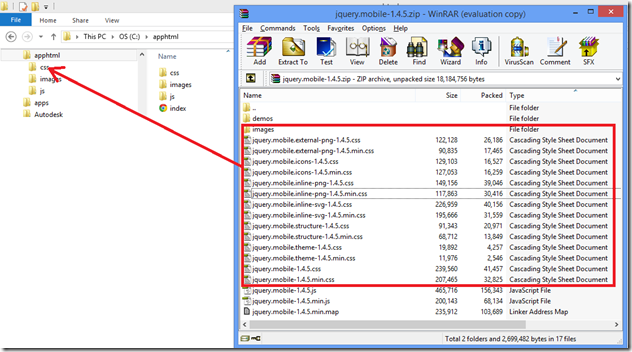
Open the jquerymobile zip files you just downloaded previously. Copy all the Cascading Style Sheet (*.css)files and the images to the css folder you created. You can do this by selecting the images folder and the css, clicking and dragging them to your css folder. *The images folder in the jquerymobile zip file contains the icons for your css interface.

Then copy the javascript files (*.js) to your js folder.

Now open the jquery file (*.js) your downloaded early in the tutorial.
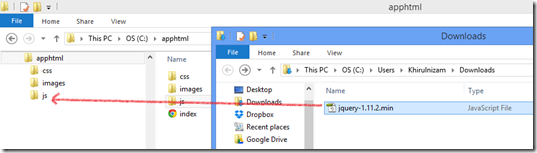
Then you got your js folder ready for jquerymobile implementation.

STEP 2: Developing the HTML interface
The mobile interface is mainly in the index.html. Use any of your HTML editor to ammend the index.html content. This is some example of the content. The first part is the jquery and jquerymobile API inclusion in the header. The template below also provide heading, content and footer divisions.

The sample code:
<!DOCTYPE html>
<html>
<head><title>Page title is here</title>
 <meta charset="utf-8">
 <meta name="viewport" content="width=device-width, initial-scale=1">
 <!-- include the jquerymobile and jquery API files here -->
 <link href="css/jquery.mobile-1.4.5.min.css" rel="stylesheet" type="text/css" />
 <script src="js/jquery-1.11.2.min.js"></script><script src="js/jquery.mobile-1.4.5.min.js"></script>
</head>

<body>
<!-- main page -->
<div data-role="page" id="home">
 <!-- header -->
 <div data-role="header" data-position="fixed">
 <h1>Header content is here</h1>
 </div>

 <!-- content -->
 <div role="main" class="ui-content">
 <p>Main content is here</p>
 </div><!-- end content -->

 <!-- footer -->
 <div data-role="footer" data-position="fixed">
 <h2>Footer text is here</h2>
 </div><!-- end footer -->
</div><!-- end of home -->
</body>
</html>
Note the viewport in one of the meta. By setting the viewport attributes to content="width=device-width, initial-scale=1", the width will be set to the pixel width of the device screen.
<meta name="viewport" content="width=device-width, initial-scale=1">
Output sample: preview in the browser.

STEP 3: Multi-page template structure
A single HTML document can contain multiple "pages" that are loaded together by stacking multiple divs with a data-role of "page". Each "page" block needs a unique id that will be used to link internally between "pages" (href="#foo"). When a link is clicked, the framework will look for an internal "page" with the id and transition it into view.
Here is an example of a three"page" site built with three jQuery Mobile divs navigated by linking to an id placed on each page wrapper. Note that the ids on the page wrappers are only needed to support the internal page linking, and are optional if each page is a separate HTML document.
- page 1 is the main page with id=”home”
- page 2 is the about page with id=”about”
- page 3 is the directory page with id=”directory”
For this exercise to work, there’s an image named logo.jpg need to be prepared in the folder images. Your company logo or any low resolution image will do.
The complete source-code of the index.html file.
<!DOCTYPE html>
<html>
<head><title>Kerul.net Company Directory</title>
<meta charset="utf-8">
<meta name="viewport" content="width=device-width, initial-scale=1">
<link href="css/jquery.mobile-1.4.5.min.css" rel="stylesheet" type="text/css" />
<script src="js/jquery-1.11.2.min.js"></script><script src="js/jquery.mobile-1.4.5.min.js"></script>

</head>
<body>

<!-- ************************** main page -->
<div data-role="page" id="home">
 <!-- header -->
 <div data-role="header" data-position="fixed">
 <h1>kerul.net</h1>
 </div>

 <!-- content -->
 <div role="main" class="ui-content">
 <p>This app provide info about the company.</p>
 <!-- provide a logo.jpg image in the folder images -->
 <img src="images/logo.jpg" width="200" height="200">
 </br>
 </div><!-- end content -->

 <!-- footer -->
 <div data-role="footer" data-position="fixed">
 <div data-role="navbar">
 <ul>
 <li><a href="#home" >Home</a></li>
 <li><a href="#directory" >Dir</a></li>
 <li><a href="#about" >About</a></li>
 </ul>
 </div><!-- end navbar -->
 </div><!-- end footer -->
</div><!-- end of home –>

<!-- ************************** about apps -->
<div data-role="page" id="about">
 <!-- header -->
 <div data-role="header" data-position="fixed">
 <h1>kerul.net</h1>
 </div>

 <!-- content -->
 <div role="main" class="ui-content">
 <p>Developer - kerul.net</p>
 <p>
 This is the a sample app developed using HTML for Kerul.net. The blog has been discussing programming since 2005. The company started publishing Android apps in the year 2010, and its apps among others are Malay Proverb Dictionary (Peribahasa) and m-Mathurat. Currently, it is working on the Windows Phone version of the apps. There are also Hijra of the Prophet Muhammad app in the Windows Phone store.

 PHP, C#, and Java are also the programming languages that the blog is familiar with.
 </p>
 <a href="http://kerul.net" class="ui-btn ui-icon-action ui-btn-icon-right ui-btn-corner-all" target="_blank"> go to kerul.net</a>
 </br>
 </div><!-- end content -->

 <!-- footer -->
 <div data-role="footer" data-position="fixed">
 <div data-role="navbar">
 <ul>
 <li><a href="#home" >Home</a></li>
 <li><a href="#directory" >Dir</a></li>
 <li><a href="#about" >About</a></li>
 </ul>
 </div><!-- end navbar -->
 </div><!-- end footer -->
</div><!-- end of home –>

<!-- ************************** direktori page -->
<div data-role="page" id="directory">
 <!-- header -->
 <div data-role="header" data-position="fixed"Available link for download
Monday, March 6, 2017
mobile phone lumia730 dual sim dcmpid bmc src google Brand
mobile phone lumia730 dual sim dcmpid bmc src google Brand

Available link for download
Friday, March 3, 2017
mobile phone lumia635 3
mobile phone lumia635 3

Available link for download
Saturday, February 25, 2017
Mobile Phone Repairing Tools Equipment
Mobile Phone Repairing Tools Equipment
When selecting tools and equipment for repairing mobile phones, it is very important to select the best tools. Cheap or inexpensive tools and equipment may not be handy when repairing a mobile. On the other hand, best quality little expensive tools and equipment will help you to repair a mobile phone easily and comfortable.
There are hundreds of tools for mobile phone repairing available in the market. It is important to select the best brand. Below all the tools and equipment needed for mobile cell phone repairing:
1) Soldering Iron : Used to solder small components like capacitor, resistor, diode, transistor, regulator, speaker, microphone, display etc. A 50 watt soldering iron is good enough for most mobile phone repairing job. When buying a soldering iron, select the one that is easy to hold and does not burn you hand. The soldering iron must have option to choose and select different types and shapes of soldering tips or bits. These tips or bits must be replaceable.

2) Soldering Station : A soldering station has 2 units – a station and an iron. It has option to control temperature depending on the heat requirement of the soldering job being done. The soldering iron is attached with the soldering station. It is better and more convenient than traditional soldering iron. It makes soldering work much easier and faster.

3) PCB Holder / PCB Stand : A PCB (Printed Circuit Board) holder or stand is used to old the PCB of a mobile phone while soldering or repairing. It holds the PCB very strongly and doesn’t allows it to move thus helping in repairing.

4) Solder Wire : Solder wire is used to solder electronic components, ICs or jumper. Composition of most solder wire is Tin / Lead in the ratio 60:40 or 63:37. Since the introduction of RoHS (Restriction of Hazardous Substances) from electronics, more and more companies are using lead-free solder. Lead-free solder wire is available in many compositions but the most common composition is Tin / Silver / Copper in the Ratio 96.5:3.0:0.5. Solder wire is available in different diameters such 2.0mm, 1.5mm, 1.0mm, 0.5mm, 0.2mm etc. For mobile phone repairing 0.5mm solder wire is best suitable.

5) Thinner or PCB Cleaner : Thinner or PCB cleaner is used to clean the PCB of a mobile phone. The most common PCB cleaner used in mobile phone repairing is IPA or Isopropyl Alcohol. It is important to buy only good quality PCB cleaner as poor quality PCB cleaners can damage the board.

6) Jumper Wire : This is a thin laminated or coated copper wire used to jumper from one point to another on the track of a mobile phone while repairing. Most people doing the work of mobile repairing do jumper to solve many problems.


8) Point Cutter : It is used for cutting.

9) Nose Cutter : It is used for cutting.

10) Precision Screwdriver : It is used to remove and tighten screws while assembling and dissembling a mobile phone. Precision screwdrivers of sizes T4, T5, T6 and forehead are good for most mobile repairing job.

11) Tweezers : These are needed to hold electronic components, ICs, jumper wire etc while soldering and Desoldering.

12) Brush : These are used for cleaning the PCB of a mobile phone while repairing. It is important to buy only ESD-Safe cleaning brushes.

13) Multimeter : Used to find faults, check track and components. Always buy a good quality reliable ESD-Safe digital Multimeter for mobile repairing works.

14) Hot Air Blower : It is also called SMD (Surface Mount Device) rework system and SMD repair system. It has control to regulate or manage temperature and flow or hot air. Always buy a good quality ESD-Safe hot air blower.

15) Battery Booster : It is used to boost the power of battery of a mobile phone.

16) Ultrasonic Cleaner : Used to clean PCB of a mobile phone and electronic components.

17) BGA Kit : Used to Reball and repair ball-type ICs. BGA stands for Ball Grid Array.

18) Magnifying Lamp : It is used to see the magnified view of the PCB of a mobile phone. Most magnifying lamps also have light. Magnifying lamps are available in different magnification such as 3x, 4x, 5x, 10x, 50x etc.

19) Mobile Opener : These are used to open the housing or body of a mobile phone.

20) DC Power Supply : Regulated DC (Direct Current) power supply is used to supply DC current to a mobile phone. Most repair person used DC power supply to switch ON a mobile phone without battery.

21) Liquid Flux : It is used to clean PCB track and legs or pins of electronic components while soldering. Liquid flux improves quality of soldering. Kester flux is world renowned for good quality.

22) Paste Flux : This is also used while soldering.

23) Solder Paste : This is solder in molted semi-solid form. It looks like paste. Solder paste is mainly used for Reballing of ICs.

24) Cleaning Sponge : This is used to clean tip of soldering iron while soldering.

25) Desoldering Wire : Desoldering wire or Desolder wire is used to remove excess solder from track of PCB.

26) Screwdriver Kit : It has several screwdrivers of different shapes and sizes to dissemble and assemble a mobile phone.

27) IRDA or Infrared Workstation : This machine is similar to hot air blower. Only difference is that it gives heat through infrared. It is very precise and give heat only where it is needed thus preventing any damage to nearby electronic components on a PCB.

28) LCD Tester : Used to check whether LCD screen of a mobile phone is faulty or not.

29) Microscope : It is used to see a magnified view of PCB or electronic components. These are available in different zoom options. Many microscopes can also be connected to a computer or a monitor.

30) Test JIG Box : This device is used to diagnose and find fault or problem in a mobile phone. It helps the mobile phone to work and function normally outside its case. This helps to test and check voltage and other test points on the PCB. It simple words it helps the a mobile phone to work without battery.

31) Wrist Strap : It is work in the wrist of the person who is repairing a mobile phone. It helps to discharge or ground static charge thus preventing the PCB or electronic components from any damage.

32) Antistatic Hand Gloves : It is important to wear ESD-Safe hand gloves while repairing a mobile phone to prevent PCB and electronic components from static charge.

33) Antistatic Mat : It is laid or placed on the table or workbench where mobile repairing is done. The mat is grounded using a grounding cord or normal grounding wire. This also prevents damage from static electricity.

34) Antistatic Apron : It is a dress work by people who repair mobile phones. This also helps to discharge static electricity.

35) Smoke Absorber : This is like an exhaust fan that helps to filter smoke that comes out while soldering and Desoldering.

36) Battery Tester : This device is used to test and analyze status or condition of battery of a mobile cell phone.

Available link for download